At a budget review, a founder hears that a campaign generated demos for $120 each. “Good,” she says. “What happens if we put another $1,500 into it?” The report on her screen answers a question about money the company has already spent. She needs evidence about the next purchase.
In this fictional case, a small software company spends $6,000 per market per month on paid search. Its sales team has room for more demos. The team can afford up to $150 for each additional demo accepted by sales. At that price, an extra $1,500 must produce at least ten additional accepted demos to justify repeating the spend.
Write the decision before buying the traffic
Put the funding rule on the same page as the campaign brief. Here an accepted demo is a first appointment with a company in the target segment, confirmed by a sales rep. A duplicate booking or an existing customer asking for support does not count. Agree that definition with the person who checks the leads. Otherwise a change in the sales team's labelling can look like a change in demand.
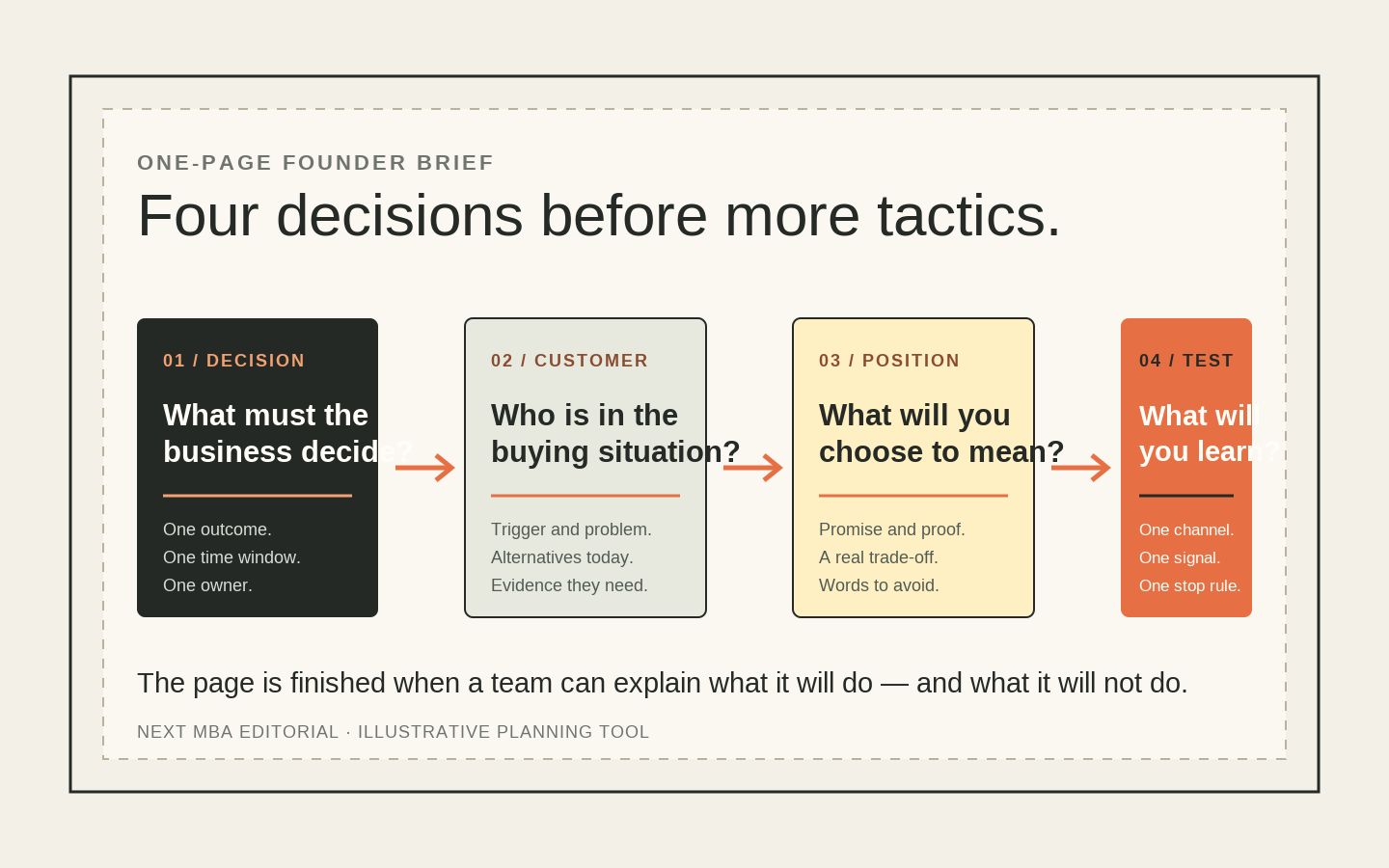
Set the review window using your own bookings. If sales normally needs a week to qualify appointments, allow that week after the test before closing the figures. Keep each booking in the period when it was generated and apply the same follow-up window to both groups. The one-page marketing strategy brief can help pin down the customer segment and offer before the budget discussion.
Choose a market where spend will stay steady
The company picks two regions with similar audiences and broadly similar demand over several previous periods. Region A keeps its $6,000 allocation. Region B receives $7,500 for one month. Both keep the same offer, landing page and qualification process. Write down anything local that might affect demand, such as a trade fair, a holiday or the loss of a sales rep.
A second region gives the team a rough estimate of what might have happened without the increase. This estimate depends on the regions moving similarly. If demand in B was already accelerating, the comparison will give the extra spend too much credit. Plot the weekly figures for both regions before committing the money.
Calculate the cost of the extra demos
| Market | Before | During test | Change |
|---|---|---|---|
| A · steady spend | 39 | 41 | +2 |
| B · extra $1,500 | 40 | 51 | +11 |
Allowing for the two-demo rise in A leaves an estimated nine additional demos in B. Divide $1,500 by nine and the estimated cost is about $167 per additional demo. Dividing the same spend by all eleven would give about $136. Those two answers fall on opposite sides of the team's $150 limit.
One appointment could change this decision. Check duplicates, cancellations and appointments still waiting for review. Keep the original counting rule when resolving those cases. If a market held a one-off event or the counts are too noisy to distinguish useful effects, record that uncertainty and design a better comparison.
Give the founder a decision she can sign
Try a three-sentence memo. “We agreed to buy at least ten additional accepted demos for $1,500. We estimate nine, at about $167 each, using region A to adjust for the background rise. We recommend returning B to $6,000 and checking the same question across more comparable markets before changing the quarterly budget.”
For your own memo, fill in the extra spend, the additional outcome it must buy and the date when the data will be ready. Ask the budget owner to name one result that would make them authorise the increase and one that would make them stop. If both answers produce the same decision, use the money elsewhere.
For guidance on setting a hypothesis and choosing success measures before a campaign experiment, see Google Ads’ guide to experiments. The matched-market calculation above is an original NEXT MBA exercise.
Build your marketing plan
Explore the Master in Marketing curriculum, from understanding customers to choosing campaigns and measuring results.
Explore Master in Marketing