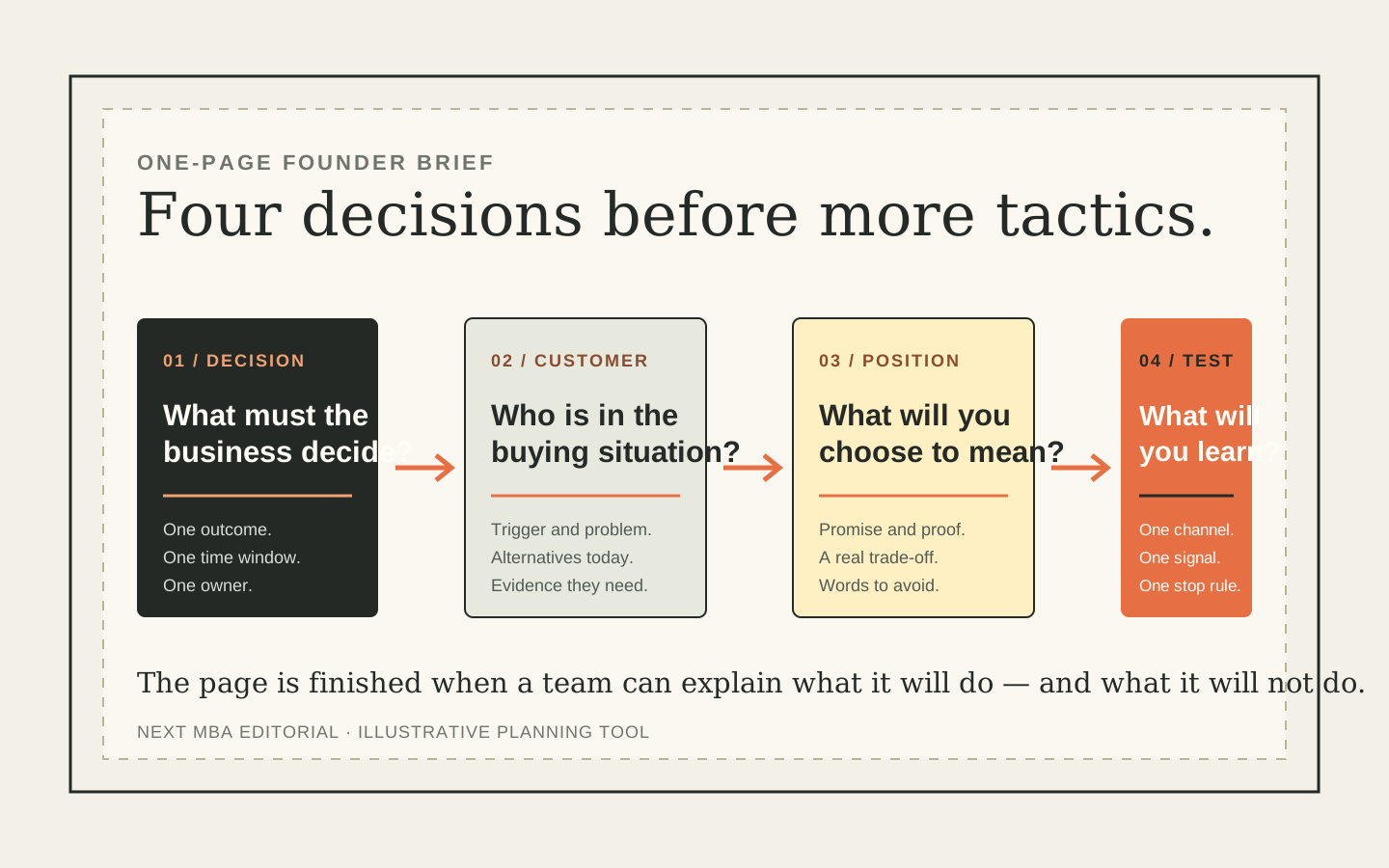
A founder says the company needs more leads. The team opens a list of possible tactics: search, partnerships, events, email, social posts and paid campaigns. Every idea sounds plausible. None of them says which customer should choose the company, why, or what the business needs to learn next.
That is a planning problem before it is a channel problem. A marketing strategy does not need to begin as a long presentation. The first useful version can be one page of explicit choices: the business decision, the customer situation, the alternative you are trying to displace, the promise you can support and the first test.
This guide provides an original working template for that page. It will not choose the strategy for you, and it does not guarantee demand. Its purpose is to make assumptions visible enough for a team to discuss, test and revise.
Start with the business decision, not the campaign.
“Grow awareness” is difficult to use because it does not say what the business must decide. Try a question with a time window instead: “During the next quarter, should we focus our limited acquisition effort on finance leaders at growing agencies or operations leaders at professional-services firms?”
The answer may still change. That is healthy. The question gives research and experiments a purpose. It also stops the team treating every possible audience and channel as an equal priority.
Write one outcome beside the decision. It might be to validate a repeatable sales conversation, learn whether a particular problem creates urgency, or determine whether an offer can support a target acquisition cost. Use the evidence your business can actually collect. Do not substitute an impressive activity count for the decision you need to make.
Put seven connected decisions on one page.
Use the following sections as boxes, not chapters. Aim for one or two sentences in each. If a box needs a page of explanation, link to the evidence rather than hiding the choice inside it.
| Decision | Question to answer | What to avoid |
|---|---|---|
| 1. Business outcome | Which decision or result matters in this time window? | A permanent mission or a list of activities. |
| 2. Customer situation | Who experiences which trigger, constraint or job now? | “Everyone who could benefit.” |
| 3. Current alternative | What do they do, buy or postpone today? | Comparing only with businesses that look like yours. |
| 4. Promise | What useful change can you credibly offer? | A slogan that could describe any company. |
| 5. Evidence | What verified facts reduce doubt about that promise? | Unverified statistics, testimonials or guarantees. |
| 6. Positioning trade-off | What will you emphasise, and what will you not claim to be? | Trying to be fastest, cheapest and most comprehensive at once. |
| 7. First test | Which audience, message and channel will you test, and what signal changes the next decision? | Launching many channels without a learning rule. |
Keep the relationship between the boxes visible. A channel follows the customer situation and promise; it does not create them. Evidence supports the promise; it is not decorative proof added after the copy is written. The test should help resolve the original business decision.
If you want help reviewing the work rather than inventing it from scratch, the guide to AI marketing for small business includes a bounded briefing and fact-checking process.
A fictional example: invoicing software for specialist firms
Imagine a small software company whose product helps professional-services firms prepare invoices from project records. The following brief is illustrative. It is not a NEXT MBA customer case, market finding or measured result.
The example is deliberately specific about what is not known. Eight interviews would not prove the size of a market or forecast conversion. They could reveal whether the situation is real enough to justify the next test, which words customers use and which controls matter before adoption.
A decision rule makes the test more useful. For example: continue only if several independent conversations describe the same costly workflow and the company can support the records and approvals they require. Define the exact threshold before the test, with the people accountable for the decision. A stop rule is not pessimism; it prevents a weak signal from turning into an endless campaign.
Draft the page in a 90-minute working session.
Bring the founder, the person closest to sales or customer conversations, and whoever must deliver the promise. Use current evidence: call notes, support questions, product constraints, win-and-loss reasons and approved performance data. Leave confidential customer information out of shared AI tools or documents unless its use is authorised.
- 10 minutes — frame the decision. Agree the outcome, time window, owner and what will change when you have an answer.
- 15 minutes — describe the customer situation. Name a trigger and the person dealing with it. Record what is observed and what is assumed.
- 15 minutes — map alternatives. Include internal workarounds, delay and doing nothing, not only direct competitors.
- 15 minutes — write the promise and evidence. Separate a desired benefit from facts that currently support it.
- 10 minutes — choose the trade-off. Finish the sentence: “For this test, we will be known for ___, not ___.”
- 15 minutes — design one test. Choose one audience, message, route to reach them and observable signal.
- 10 minutes — assign the review. Name the owner, evidence to capture, decision rule and review date.
The time boxes are a facilitation suggestion, not a research-backed optimum. If the group cannot agree on the customer situation, do not manufacture consensus to finish the agenda. Record the competing hypotheses and design research that distinguishes them.
Challenge the page before funding the plan.
Ask someone who did not draft the page to mark every sentence as evidence, interpretation or assumption. That simple distinction is valuable because a confident internal belief can otherwise appear beside a verified fact with no visible difference.
Then use five challenge questions:
- What would have to be true for this customer situation to create action now?
- Which alternative is easier, safer or cheaper than we have admitted?
- Which part of the promise could a customer reasonably misunderstand?
- What evidence is missing, and who can obtain it without inventing a claim?
- What result would cause us to revise the audience, promise or channel?
Keep an evidence ledger beside the brief: the source, date, owner and limitation for each important claim. Update the decision page when new evidence changes a choice, not merely because a calendar date has passed. Strategy should become more precise through learning, not longer through accumulation.
Common questions
Is a one-page brief a complete marketing strategy?
No. It is a decision layer that should guide deeper work on research, product, brand, channels, budgets, operations and measurement. Its value is making the main choices and unknowns visible before those plans expand.
Should a founder choose only one customer segment?
Not forever. A focused test can help a small team learn faster than addressing every possible segment at once. A portfolio business may need several briefs, each with a distinct decision and accountable owner.
Which marketing channel should come first?
The channel should fit how the chosen customer investigates and buys in the described situation. Treat the initial channel as a hypothesis. Choose one you can execute credibly and measure well enough to inform the next decision.
Can AI write the strategy?
AI can organise notes, surface contradictions or challenge an assumption when given reliable context. It does not remove the founder’s responsibility for the trade-offs, evidence or consequences. Do not let fluent output turn missing customer knowledge into a confident plan.
Sources and editorial note
- Harvard Online, Introduction to Entrepreneurial Marketing. Referenced for its focus on value proposition, business model and go-to-market choices for entrepreneurial ventures.
- INSEAD, Strategic Marketing Programme. Referenced for its emphasis on customer-centric strategy and connecting marketing decisions with business performance.
The seven-part brief, session plan and fictional software example are original NEXT MBA Editorial tools. They are not research findings, customer results or a guarantee of marketing performance. Source pages checked on 10 October 2026.
Develop the choices behind the plan.
Explore NEXT MBA’s 12-week live online Chief Marketing Officer Course for founders, CEOs and business leaders.
Explore the Chief Marketing Officer Course