You ask an AI to write a month of social posts. A few seconds later, you have thirty of them. By the fifth, you realise they could belong to almost any business.
Now you have a new job: explaining your offer again, removing claims you cannot support and finding something worth saying. Producing text was the easy part. Getting useful marketing work out of the exchange takes a little more care.
For a small business, a sensible first use of AI is a bounded assignment with a visible result: review one page, organise a set of questions or turn one useful source into a draft. These five tasks are examples to try with an appropriate AI tool, not promises about an automatic marketing system.
Choose work where you can recognise a good answer.
If you know your service well, you can judge whether a rewritten description is accurate. If you have no reliable data about a market, a confident market-size estimate is much harder to evaluate.
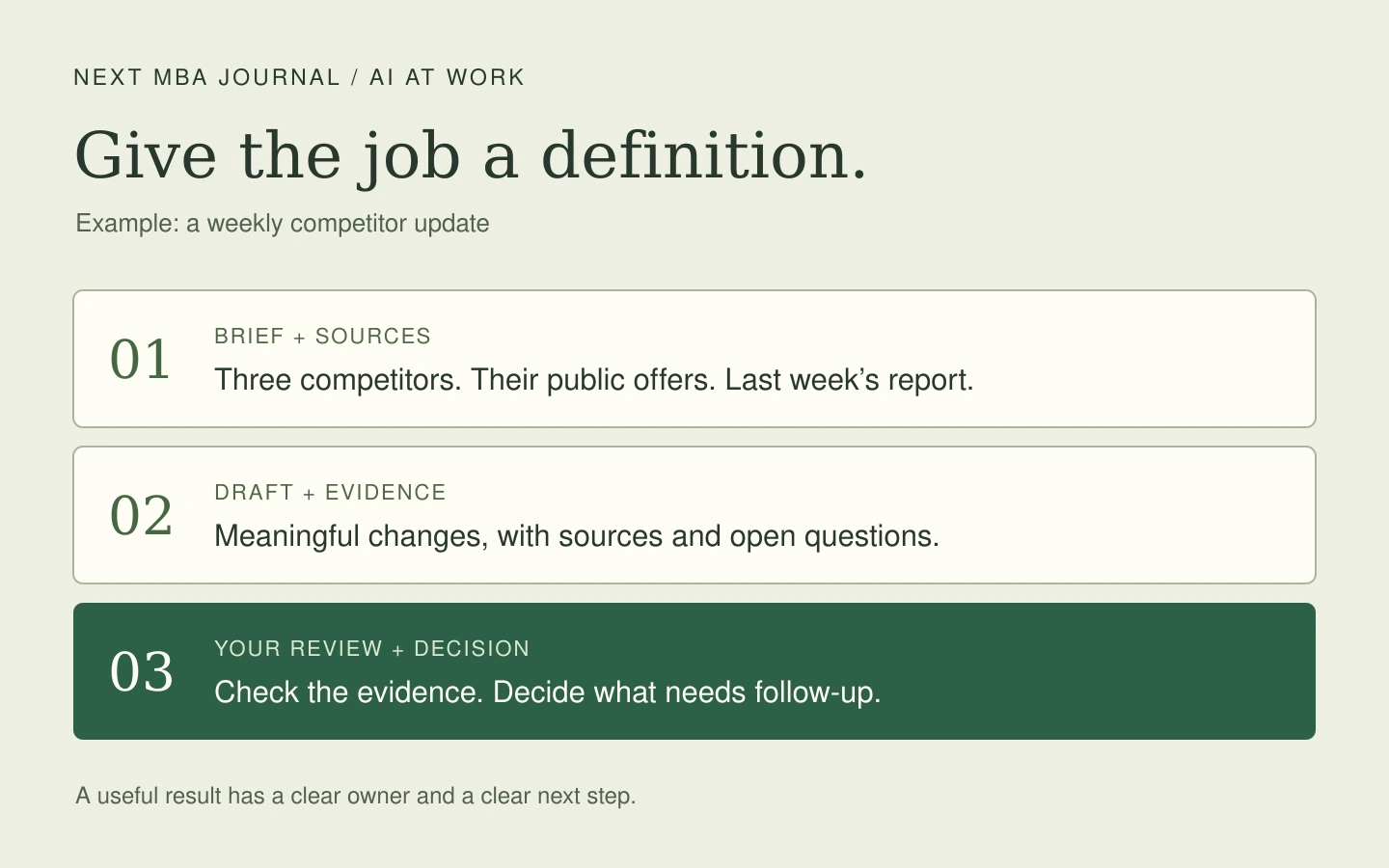
Start close to your own knowledge. Give the AI the approved service description, the intended audience and a specific deliverable. Keep the first task away from automatic publishing, customer messages or changes to paid campaigns.
This is consistent with a broader engineering principle in Anthropic’s guidance on AI agents: begin with the simplest approach that meets the need and increase complexity only when it is useful.1 You do not need an elaborate autonomous system to improve one page.
If you are still deciding what kind of help you want, our guide to AI employees, assistants and automations explains the differences. Here, the focus is the assignment itself.
Five AI marketing tasks worth trying
1. Find the gaps in a service page
Give it: The page text, an accurate description of the service and the questions people ask before buying.
Ask for: A short list of unanswered questions, followed by proposed edits. Tell the AI to flag missing information instead of filling it in.
For an imaginary bookkeeping service, “We make finance simple” leaves basic questions unanswered. Does the service include monthly reconciliation? Which records must the customer provide? When do they receive a report? An AI can help spot those gaps. Only the business can confirm the answers.
Check: Every added feature, delivery commitment and condition. A tidier sentence is not an improvement if it quietly changes what you sell.
2. Turn recurring questions into a useful FAQ
Give it: An anonymised list of questions and your current, approved answers. Remove names, contact details and private customer circumstances. Use only information you are allowed to share with the tool.
Ask for: Groups of related questions, a suggested order and concise answer drafts based only on the supplied facts. Keep unanswered questions in a separate list for your team.
A person considering your service may care less about your company story than whether they can change a booking or use the product with an existing system. Put those practical questions where someone can find them.
Check: That grouping has not erased a meaningful distinction. “Can I cancel?” and “Can I get a refund?” may need different answers. Have the person responsible for the policy approve the wording.
3. Adapt one substantial source into a few social posts
Give it: A published article, an approved presentation or a transcript you have permission to use, plus examples of your normal writing.
Ask for: Three distinct angles: one practical lesson, one question worth discussing and one worked example. Require each draft to identify the source passage it uses.
Do not ask for twenty variations of the same announcement. If an article contains a useful checklist, let one post explain a single item properly. Another might explore a limitation. They should give the reader different reasons to pay attention.
Check: That no personal experience, customer quote or result has been invented. “I learned this after losing a major client” is not acceptable first-person copy unless that really happened and you want to share it.
4. Prepare a focused newsletter draft
Give it: One genuine update, the audience, the correct destination link and any relevant terms. Explain what the reader should understand or do.
Ask for: Two subject-line options and one short email. Keep the task to drafting; sending and audience selection need their own approval.
For a workshop announcement, the useful information is likely to be the problem covered, who the session is for, the date and how to join. You can ask the AI to make that easy to scan without inventing urgency or promising a transformation.
Check: Dates, timezones, links, pricing and eligibility. Send a test through your normal process before using a real mailing list. Good copy cannot repair a broken registration page.
5. Write a test brief for one weak page
Give it: The page, the visitor’s likely goal and whatever reliable evidence you have: support questions, recorded feedback or clearly defined analytics.
Ask for: One proposed change, why it might help, what you would observe and what could make the conclusion misleading.
If visitors repeatedly ask what is included, a reasonable test might be a clearer inclusions section. “Make the page more premium” is not a very testable assignment. Nor does an AI’s confident opinion establish why people are leaving.
Check: That the proposed measure reflects the actual goal. More button clicks can be unhelpful if visitors immediately discover the offer is not for them. With very little traffic, describe observations cautiously rather than announcing a winning experiment.
Write the brief once, then reuse the structure.
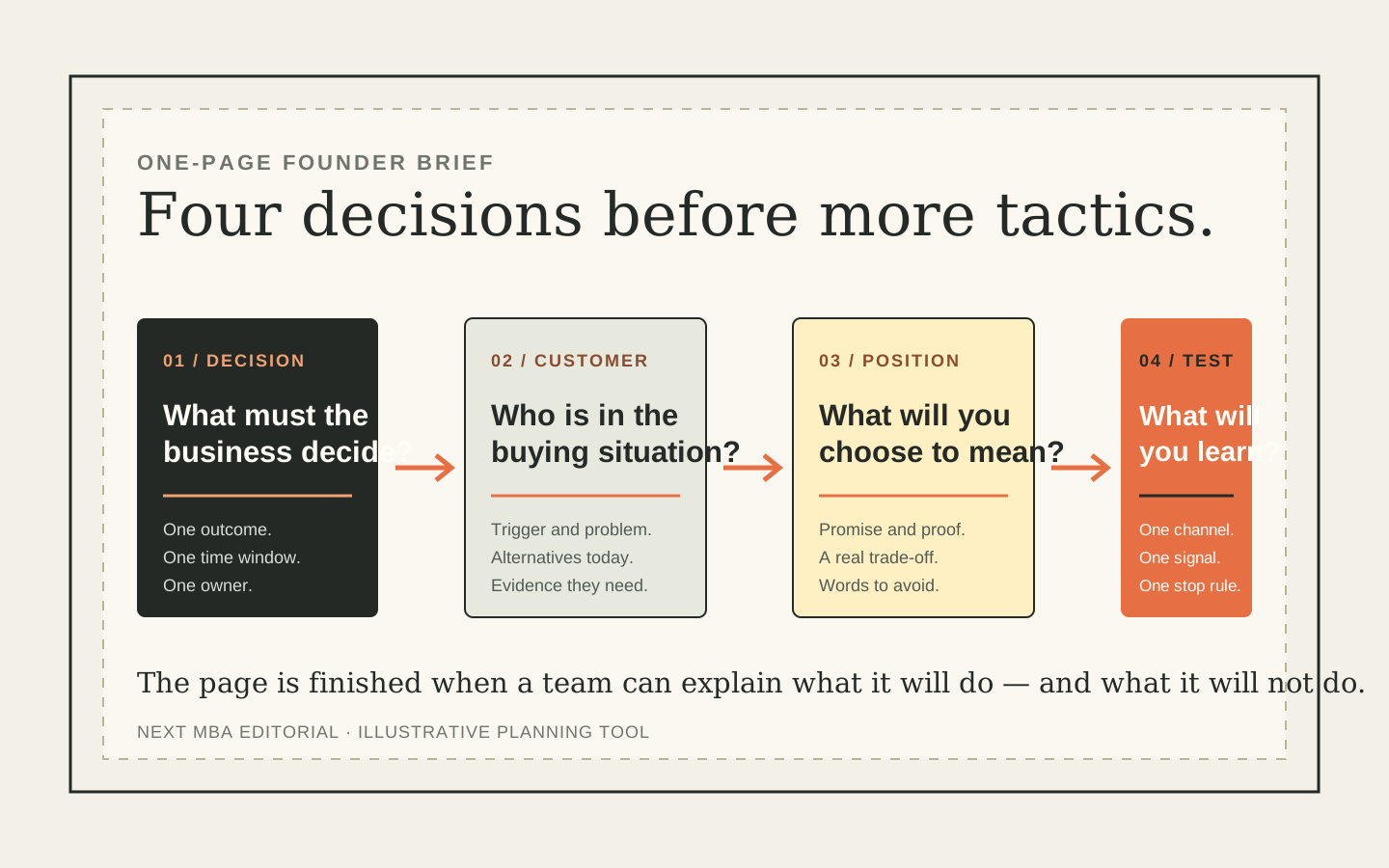
Most of the useful context is not mysterious: who the reader is, what you sell, what is true and what you want back. Make those details explicit.
The brief is fictional. Replace the details with approved information from your own business. If your chosen tool cannot access a page, provide the text; do not assume it has inspected something just because it produces an answer.
Separate fluent writing from verified information.
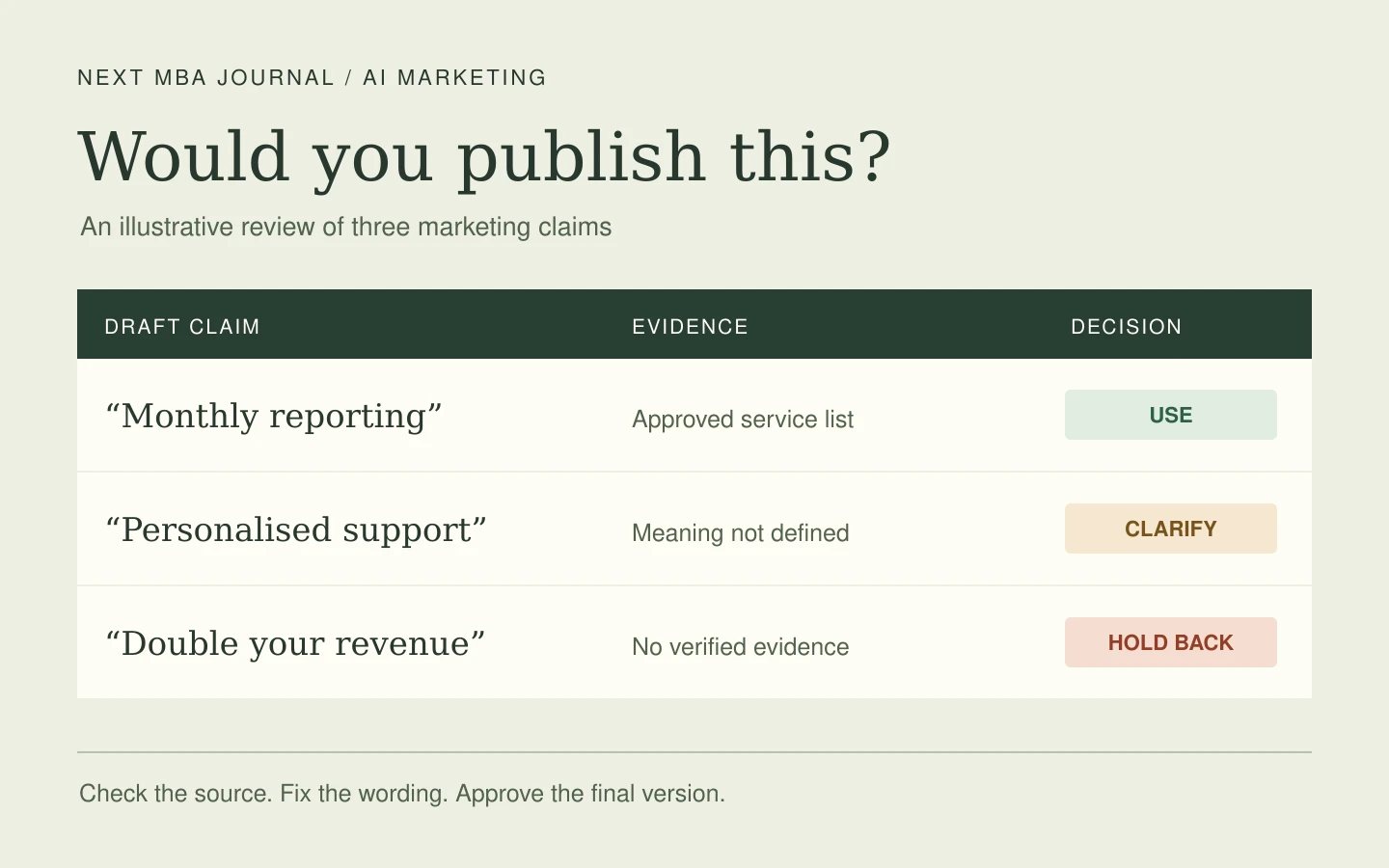
Read the output twice. First, check facts against the inputs. Then read it as a prospective customer: is the offer clear, is the wording natural, and is the next step honest?
| Check | What to look for |
|---|---|
| Facts | Features, dates, prices and policies match a current approved source. |
| Evidence | Statistics, quotations and claims have sources that actually support them. |
| Voice | The wording sounds like your business and contains no invented personal experience. |
| Usefulness | The reader learns something specific or can make a better-informed decision. |
| Action | The destination works, the offer matches the copy and a responsible person approves publication. |
For website content, Google’s guidance on generative AI emphasises accuracy, quality and relevance. It also warns that producing many pages without adding value can violate its scaled-content-abuse policy.2 More articles are not a substitute for something useful to say. AI-written pages do not come with an indexing or ranking guarantee.
Run a small trial before expanding the workload.
Pick one recurring task and complete it a few times over a week. Note the time spent preparing inputs, checking the draft and correcting mistakes. Compare that whole process with how you normally do the same work.
Also record whether you used the result and why. A draft you rejected is still informative, but it is not finished marketing. If the same facts keep going wrong, fix the source material or narrow the assignment before asking for more output.
Expand only when the result is useful enough to repeat. You may discover that AI is valuable for organising rough material but less helpful for the final opening paragraph. That is a perfectly workable division of labour.
Common questions
What is the best first use of AI for a small business’s marketing?
A small task you understand well and can review against reliable inputs. Reviewing one service page or organising known customer questions is a reasonable starting point. The best choice depends on what is currently taking your team time.
Can AI run all of my marketing?
These examples do not establish that. Choosing an offer, understanding customers, approving claims and deciding what to spend still require accountable decisions. Give tools only the access needed for the task, and keep consequential actions subject to deliberate approval.
Sources and editorial note
- Anthropic (2024). Building effective agents. Referenced for the principle of starting with a simple, appropriate approach, not as evidence of marketing results.
- Google Search Central. Google Search’s guidance on using generative AI content on your website.
The task briefs, examples and checklist are original editorial suggestions. They are not customer case studies or measured performance claims. Source pages checked on 29 September 2026.