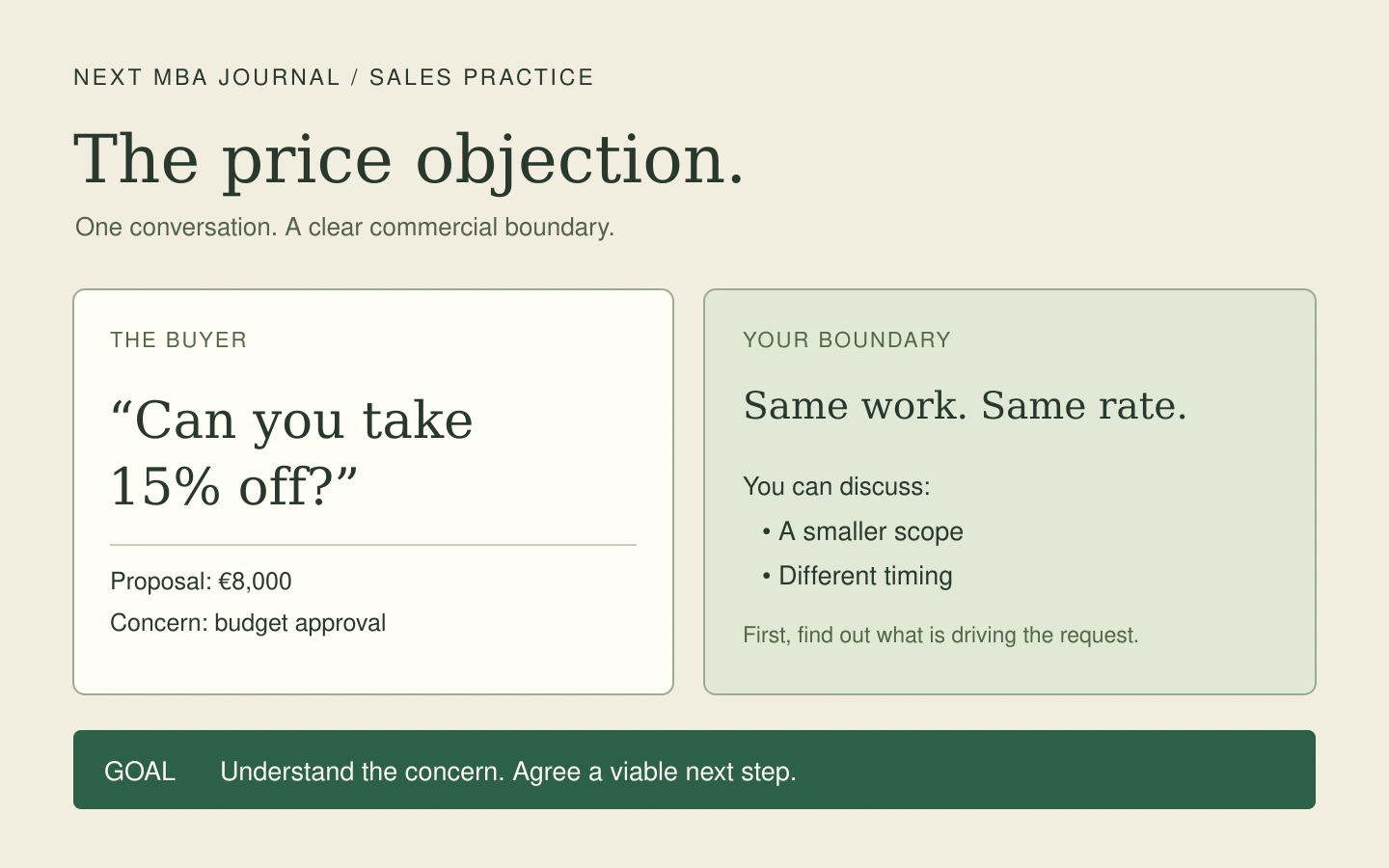
There are three minutes left on the call when procurement asks, “Can you take fifteen per cent off and send the revised quote today?” The seller nearly says yes. Then she notices the operations lead, who asked for the training in the first place, has already left the call.
Try this fictional negotiation with a colleague. The quote is $24,000 for a software rollout. Procurement needs a figure it can approve. Operations needs every team to know how to handle the new workflow. The seller has authority to change the scope and must get approval for a discount. All three facts matter.
Find out what happens at the requested figure
Seller — “If I sent an offer at that figure this afternoon, what would happen to it tomorrow?”
Buyer — “We're trying to stay within my $21,000 approval limit. Above that, the operations director needs to review it next week.”
Seller — “Thanks. The fifteen per cent would take it to $20,400. Is $21,000 itself within your limit? And which teams did operations say needed a workshop before launch?”
The question gives the buyer an easy way to explain the constraint. A different buyer might name a competitor's quote or say the project is worth less than the proposal assumes. Give that answer room to change the conversation. The guide to writing a flexible sales script includes a way to leave space for what you learn on the call.
Open the quote together
The implementation line is $18,000. Four instructor-led workshops cost $1,500 each. If the buyer needs only two facilitated sessions, the revised scope costs $21,000 at the same rates. The remaining two workshops disappear from the deliverables. Someone still has to decide how the other teams will learn the workflow.
| Quote | Delivery | Who needs to decide? |
|---|---|---|
| $24,000 | Implementation and four workshops | The director can review the original proposal next week. |
| $21,000 | Implementation and two workshops | Operations confirms which teams attend and how the others will be trained. |
Let the buyer choose a workable route
Buyer — “Two teams know the software already. Their managers could brief them if we provide the materials.”
Seller — “Let's check that with those managers. I'll send the two-workshop option with the delivery dates and a list of included training materials. Can you get their confirmation before we issue the order?”
Now try the other answer. Operations says all four teams are new and essential to launch. The seller can offer to keep the full scope and prepare a one-paragraph case for the director. If the director cannot fund it and the two-workshop option leaves the rollout exposed, close the call with the project on hold. A revised price is useful only when someone can deliver what it promises.
Rehearse what gets forwarded
Give the buyer a private instruction. In the first round, the approval limit is fixed and two workshops are sufficient. In the second, the limit is a preference and operations needs four. The seller has three minutes in each round, and the buyer should reveal the constraint only when asked a question that genuinely invites the answer.
After each round, the buyer writes the email they would send to operations from memory. Can they state the total price, the exact work removed, and who must agree? If they remember only “the supplier will do a deal”, replay the final thirty seconds. For a fresh buyer brief, use the price-objection exercise for management consulting.
Further reading on questions that reveal interests and constraints comes from the Program on Negotiation at Harvard Law School. The quote and dialogue are original practice material.
Practise the conversation out loud
Try a sales role-play with the AI sales tutor. Use the buyer’s concern from this exercise as your starting point.
Explore the AI sales tutor