Twenty minutes into your online class, you ask whether everyone is following. Nobody replies. You take the silence as a yes and move to the next slide.
Perhaps everyone understood. Perhaps they are still thinking. Perhaps the question was too vague to answer in front of a group. The trouble is that you have no useful evidence either way.
A live online class gives you a chance to see how people think and respond to what they need. Designing for that takes more than opening a video call. Here is a practical approach for a small professional-development class, with alternatives for larger groups.
Choose one thing learners should be able to do.
“Understand negotiation” is too broad to guide a single session. “Respond to a discount request by asking one useful question before offering a concession” is something you can observe.
Write the outcome before choosing slides. Then choose a task that reveals whether learners can do it. For the negotiation example, that might be a two-minute exchange in pairs followed by a revised response.
Carnegie Mellon’s Eberly Center describes active learning strategies that can sit alongside a lecture, including brief writing, discussion and problem-solving activities.1 You do not have to abandon explanation. You need opportunities to find out what learners can do with it.
For the distinction between formats, see live online classes versus recorded courses. A recording is useful for revisiting an explanation. The live session is your opportunity to respond to an attempt that is happening now.
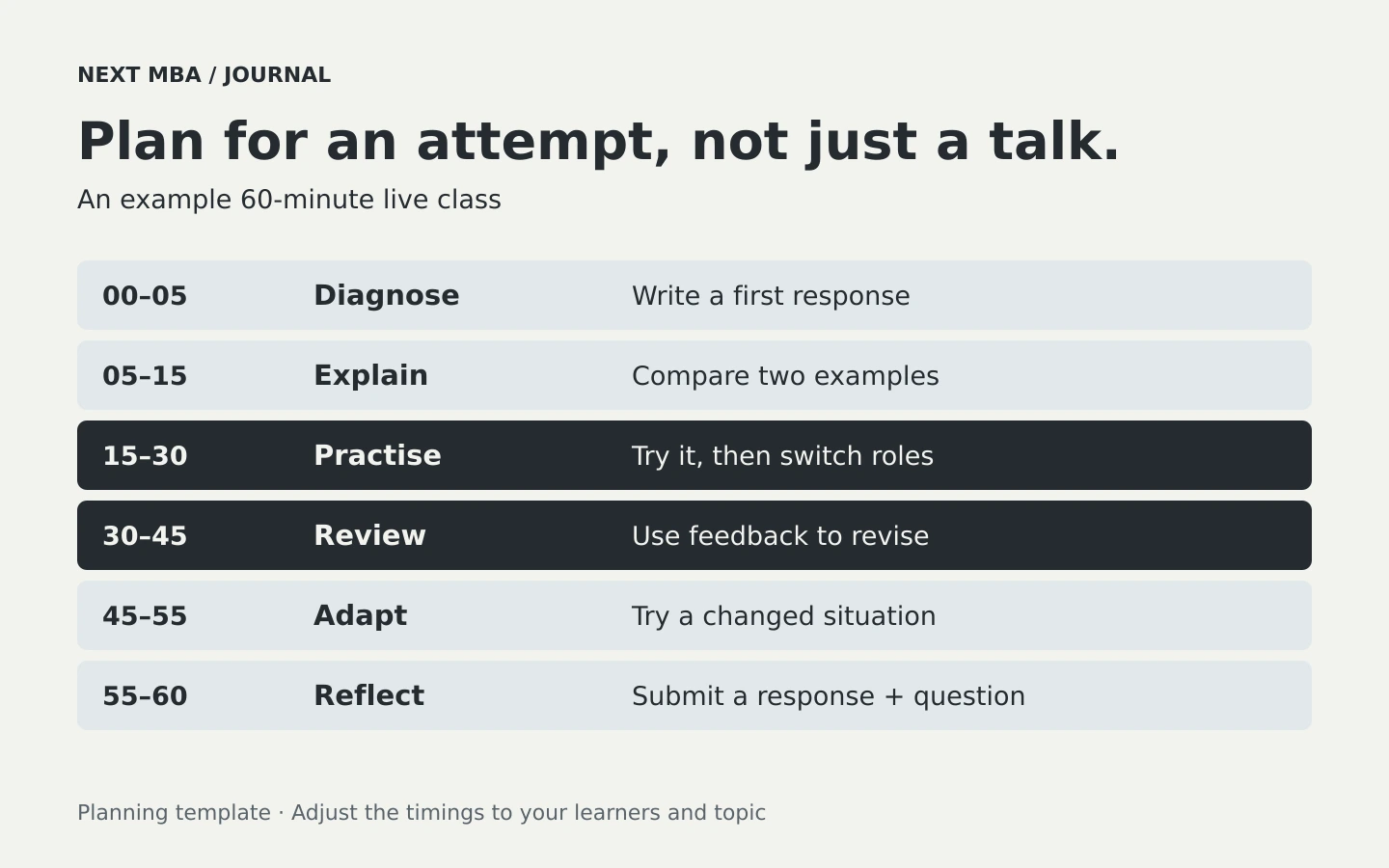
An example plan for a 60-minute class
The schedule below is an original planning template. Change the timings for the group, the topic and accessibility needs. A technical demonstration may need a longer first explanation; a familiar group may be ready to practise sooner.
| Time | What learners do | What you learn |
|---|---|---|
| 0–5 min | Write their first response to a short buyer request. | Their starting assumptions. |
| 5–15 min | Watch a worked example and compare two possible responses. | Which distinctions need explanation. |
| 15–30 min | Practise in pairs, then switch roles. | Where applying the idea becomes difficult. |
| 30–45 min | Discuss selected attempts and revise a response. | Whether feedback changes their approach. |
| 45–55 min | Try a changed scenario with less guidance. | Whether they can adapt. |
| 55–60 min | Submit one final response and one remaining question. | What to revisit next time. |
Prepare a shorter version in advance. If the first attempt reveals a basic misunderstanding, spend time there and drop an optional example. Racing through the plan to finish your slides is a poor trade if people never get a second try.
Ask questions people can actually answer.
Replace “Any thoughts?” with a specific choice: “Which response would you send, A or B, and what would you change?” Give everyone a moment to write before inviting answers. Tell the group whether you want a sentence in chat, a poll response or a spoken contribution.
For pair work, put the instructions somewhere learners can still see after leaving the main room. Include roles, the task, the time available and what they should bring back. “Discuss pricing” leaves too much to guess.
Offer a text-based route for someone who cannot use their microphone. In a large class, ask learners to submit individual responses and discuss a few with permission. Do not make speaking on camera the only way to show understanding.
During the debrief, comment on observable choices. “You offered a discount before finding out why the buyer asked” gives someone a concrete next move. “Be more confident” does not.
Use AI to prepare variations and test your instructions.
An AI tool can help you draft a second scenario, suggest likely misunderstandings or check whether an exercise brief leaves out a step. Keep the subject expert in charge of the facts and the teaching goal.
Try this preparation prompt:
Work through the exercise yourself before class. Does it have enough information? Is more than one answer defensible? Can a beginner understand the instructions without your private notes? An AI-generated scenario can sound realistic while being impossible to complete.
If you use AI practice between sessions, connect it to the same outcome and ask learners to bring back a specific attempt. Our sales roleplay guide provides examples. Avoid grading learners from an unexamined AI score; look at their work and explain the criteria.
Send something people will use after the call.
A follow-up can be short: the core idea, one worked example, the exercise instructions and the next action. If a replay is available, make the relevant section easy to find. Check recording arrangements and participant permissions before sharing contributions beyond the class.
Choose a follow-up task that fits an ordinary working day. For example: before your next customer call, write the question you will ask if price becomes an issue. Afterwards, note what you heard and whether it changed your response.
Use the final submissions to plan the next session. If learners can repeat the phrase you taught but cannot adapt it when the buyer’s concern changes, give them another contrasting example. Attendance tells you who arrived; an attempted task tells you more about what to teach next.
Common questions
How long should a live online class be?
Long enough for the intended task, explanation and feedback, with breaks where needed. The hour in this guide is a planning example, not a universal optimum. Reduce the number of outcomes before squeezing every activity into less time.
What if nobody speaks?
First check whether the question is clear and whether people have had time to think. Offer a written response or a choice between examples. Do not assume silence means either agreement or lack of interest.
Do I need slides?
Only where they help. A visible problem, a short demonstration and a shared exercise may be enough. Keep instructions available in text so learners do not have to remember everything you said.
Source and editorial note
- Carnegie Mellon University, Eberly Center: Active Learning Strategies.
The lesson schedule, exercise and prompt are original editorial examples. They are not a measured teaching intervention or a guarantee of learning outcomes. Source checked on 30 September 2026.
Bring your expertise to a live classroom.
Explore NEXT MBA’s platform for teachers and live learning.
Explore NEXT Platform