Your project is running late. You need two more days for testing. You can explain the reason perfectly well in your own language. In English, you hear yourself saying, “We have some problems,” and leave your colleagues guessing.
That is a useful target for business English speaking practice: explain the situation, give a reason and ask for a decision. You do not need a more impressive vocabulary to begin. You need a chance to say the thing you will actually have to say.
An AI conversation tool can take the other side of a rehearsal. Give it a role, a problem and a reason to ask follow-up questions. The exercises below work with a tool that accepts custom instructions, or with a colleague. They are fictional examples you can adapt, not a description of every language app’s features.
Start with a meeting, not a topic.
“Let’s talk about business” leaves too much open. “You are my project manager; I need to explain why Friday’s delivery should move to Tuesday” gives both sides something to do.
Write down who you are speaking to, what they already know and what needs to happen by the end. Keep the situation small. A two-minute update is easier to review than an imaginary forty-minute strategy meeting.
Choose language that helps you perform a job: checking an instruction, disagreeing without dismissing someone, or confirming a deadline. The British Council’s speaking materials also organise practice around communicative situations, including checking understanding and expressing disagreement.12 You can use those lessons for additional listening and phrase practice.
Use invented names and simplified details. Your practice partner does not need your customer’s contract, a colleague’s private feedback or an unpublished forecast to ask you a difficult question.
Five business English speaking exercises
1. Give a project update with a clear request
Situation: A website launch is due on Friday. Testing needs two more days. Your manager wants to know whether the whole launch must move or whether a smaller release is possible.
Try saying: “The pages are ready, but payment testing needs two more days. I recommend moving the launch to Tuesday. Can we agree that today?”
Ask your partner to: Question one part of the plan. Your job is to explain the trade-off and finish with a decision or a named next step. If the listener still does not know what you are asking for, work on the request before polishing the grammar.
2. Check an instruction you did not understand
Situation: A colleague asks for “the numbers before the review”. You do not know which figures they need or when the review starts.
Try saying: “When you say the numbers, do you mean this month’s sales or the forecast? And what time do you need them?”
Ask your partner to: Leave one detail unclear until you ask about it. End by repeating the agreement in your own words. The exercise is complete when you know what to send and when—not when you have managed to avoid asking a question.
3. Disagree and offer a workable alternative
Situation: Your team wants to advertise a service before the booking page is ready. You are concerned that people will arrive with nowhere to book.
Try saying: “My concern is the booking page. Could we finish that first and start the campaign on Thursday?”
Ask your partner to: Explain why starting earlier matters. Listen to that reason and adjust your proposal if appropriate. Do not rehearse a speech so fixed that the other person’s answer becomes irrelevant.
4. Set a boundary with a client
Situation: A client asks for an extra report tomorrow. It is outside the agreed work, and your team is already committed to another delivery.
Try saying: “We can prepare the report next week. If you need it tomorrow, we would have to move the other delivery. Which is more important for you?”
Ask your partner to: Push once for both. Practise staying polite without making a promise you cannot keep. The aim is to make the options understandable, not to find a clever way of saying no.
5. Explain your work to someone outside your field
Situation: You meet a potential collaborator who has no background in your industry. They ask what you do.
Try saying: “I help small hotels organise bookings from different websites. The aim is to make it easier for the reception team to see what is available.”
Ask your partner to: Ask one basic question and one practical question. Explain without specialist abbreviations. Afterwards, ask them to describe your work back to you. The gap between the two versions is useful feedback.
A worked dialogue: ask for a decision, not just more time.
This fictional exchange develops the first exercise. Read it once, then close the example and explain the same problem in your own words. The aim is not to memorise these sentences.
What changed? You clarified what “part of the site” meant, responded to the campaign constraint and separated a proposal from an agreed decision. The next action is a check and a message at three—not an approved Friday launch. A fluent summary that says “we agreed to launch Friday” would misrepresent this conversation.
On the second attempt, ask your partner to change one fact: the campaign can move, the technical check fails, or the manager cannot decide today. Respond to that new fact instead of repeating the example. British Council materials on questioning and clarifying provide additional practice in probing meaning and summarising responses.3
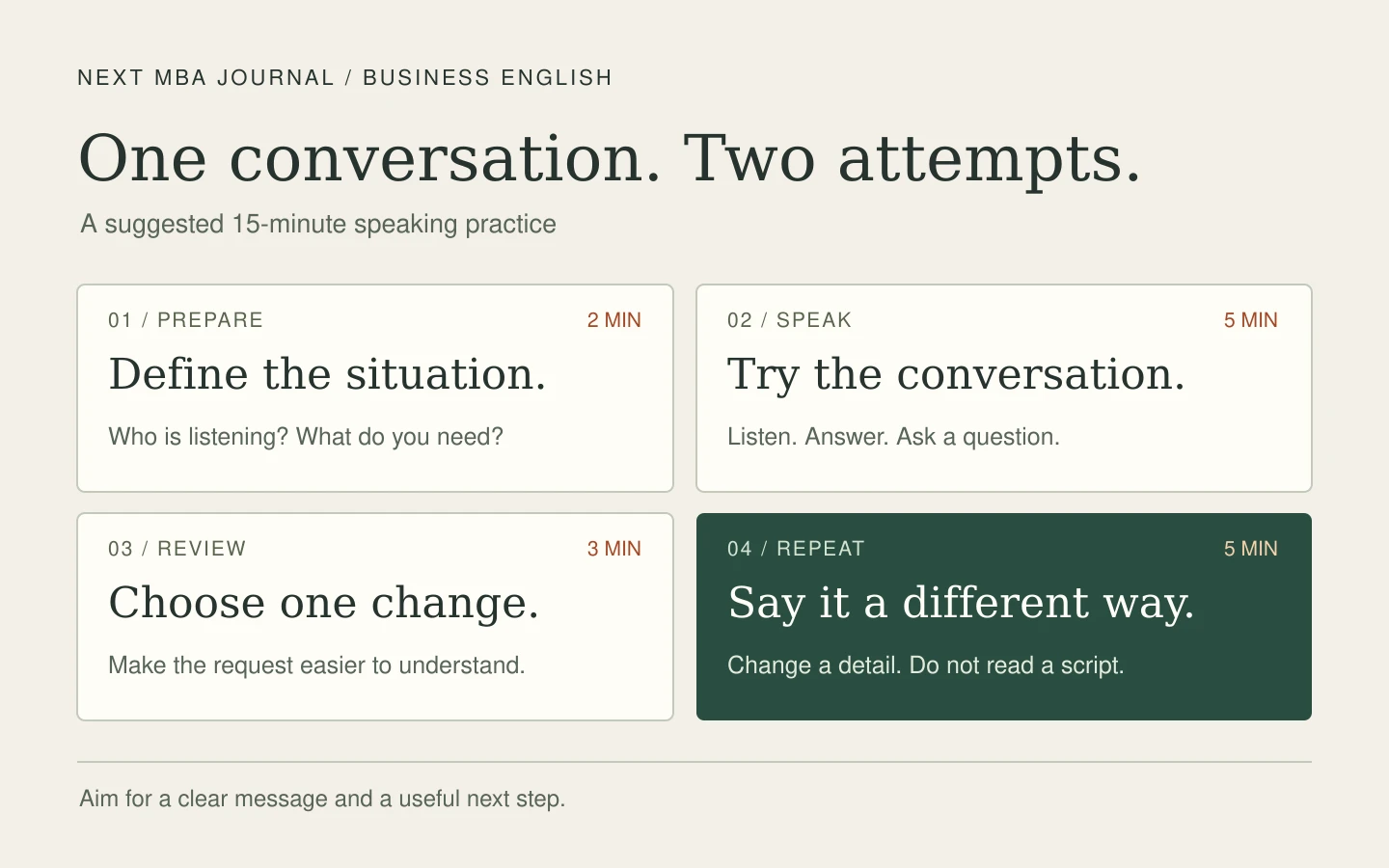
A 15-minute routine you can fit around work
Use this as a suggested structure. Extend a stage when it helps; there is nothing special about the exact number of minutes.
- 2 MINUTES / PREPAREDefine the outcome
Write the situation and the one thing your listener needs to understand or decide.
- 5 MINUTES / SPEAKHave the conversation
Let the partner respond. Keep going if a sentence is imperfect but understandable.
- 3 MINUTES / REVIEWChoose one adjustment
Find a moment where the message was unclear. Make the request, reason or next step more specific.
- 5 MINUTES / REPEATChange one condition
Try again with a different deadline, question or objection, without reading a script.
Keep a small note after the session: the phrase you wanted, the phrase you used and what you will try next. A page full of corrections is not necessarily something you can remember during tomorrow’s call.
A reusable AI speaking-practice prompt
If the tool only accepts text, you can still practise composing a response and then say it aloud. That does not give the tool evidence about your pronunciation. For spoken practice, use a voice-enabled tool and check which audio or transcript information its feedback actually uses.
Check whether the feedback matches the conversation.
An AI suggestion can sound authoritative and still be unsuitable. Look for the exact sentence it is correcting. If a transcript changed a word you said, correct the transcript before drawing a conclusion about your English.
Ask for a plain version of a sentence before a more formal one. “Could you send the draft today?” may suit the situation better than an elaborate expression you would never use naturally. The aim is language you can use under pressure.
Listen for three things on the second attempt: did you explain the point, respond to the question and confirm the next step? Bring recurring difficulties to a teacher, particularly when feedback about tone or pronunciation is confusing. Our guide to learning with AI at work explains how to connect rehearsal with human feedback.
Keep a review sheet with evidence, not a fluency score.
Copy these four lines into your notes after each attempt. The filled example refers only to the fictional conversation above.
- My intended decision: choose a safe launch plan.
- What I actually clarified: “part of the site” means information pages without payment.
- What is agreed, and what is not: I will send two options at three; the launch plan is still undecided.
- One change for my next attempt: make the request earlier, then pause for the other person’s answer.
Ask your partner to point to the words that support each answer. If the conversation never established an owner or deadline, write “not agreed” rather than filling the gap. This is a reflection tool, not a validated language assessment. A second attempt is useful evidence about that exercise, not proof of general fluency or workplace performance.
Choose the next exercise by the difficult moment.
- The request is vague: try asking for clarification in a supplier meeting. Find the missing detail before making a commitment.
- People seem to agree, but mean different things: try checking understanding in team planning. Restate the proposed priority and invite a correction.
- Your update takes too long: try giving a concise team-planning update. Separate progress, uncertainty and the next action.
Each page provides a fictional situation and a working sheet. You can practise with a colleague or adapt the situation for an AI tool that supports it. Browse the business English exercise library for a different work context. These public exercises do not require buying a language-coaching product.
Common questions
Can AI help me practise business English every day?
It can provide a conversation partner when the tool is available. Keep each session tied to a particular situation and review the feedback critically. Regular use is not a guarantee of a particular language level or improvement by a deadline.
Do I need advanced English to begin?
No. Start with a short exchange, such as confirming a date or explaining your job. Ask for shorter questions and simpler wording. If you cannot follow even after that, prepare useful phrases with a teacher or a structured lesson before repeating the exercise.
Should I try to remove my accent?
Make being understood the immediate goal. If a particular word repeatedly causes confusion, work on that word with reliable audio or a teacher. Do not treat an automatic transcript or a model’s opinion as a definitive pronunciation assessment.
Sources and editorial note
- British Council LearnEnglish. Checking understanding.
- British Council LearnEnglish. Agreeing and disagreeing.
- British Council TeachingEnglish. Negotiations 3: Questioning and clarifying. Consulted 16 October 2026.
The situations, sample replies, prompt and practice schedule are original editorial exercises. They are not a validated assessment, a formal language course or evidence of a specific learning outcome. Source pages checked on 29 September 2026.
Updated : added the worked dialogue, evidence-based review sheet and links to focused practice exercises. Original publication: 29 September 2026.